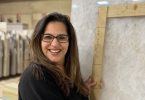
Anastasia Barnes, CEO of High-Profile Monthly, recently interviewed Shabana Basij-Rasikh, founder of School of Leadership, Afghanistan (SOLA) and a global advocate for girls’ education whose leadership has been shaped by courage, conviction, and long-term vision. She was recently named one of 10 winners of this year’s Elevate Prize, which awards grants and services to social changemakers working to strengthen communities and expand opportunity at a critical moment.
While her work is outside the construction industry, Shabana’s experience will feel familiar to many women in architecture, engineering, and construction. She has led in spaces not built for her, navigated resistance, and continued to move forward anyway. As the keynote speaker for this year’s Women Who Build Summit, Shabana brings a perspective that transcends industries and speaks directly to what it means to lead, build, and persist.

Shabana Basij-Rasikh
Anastasia Barnes: You’ve spoken about building something even when the system around you wasn’t designed to support it. In architecture, engineering, and construction (AEC), many women are navigating workplaces and cultures that weren’t built with them in mind. What helped you keep building anyway, especially when the resistance felt structural rather than personal?
Shabana Basij-Rasikh: SOLA was the first school in Afghanistan that dared to do what we did. It was the first boarding school for girls in Afghan history – a school for girls from all provinces, from rural areas and from cities, for girls from all economic and ethnic backgrounds. It is a school where these students can come together, live and learn together, and understand that they are not defined by what makes them different. They are defined by what unites them, all together, as Afghans.
This was the SOLA model, our innovation and our bold idea, and I remember talking about it with high-level government officials in Kabul, back in our early days. These officials, all men, were not extremists. They weren’t associated with the Taliban in any way. They were very enthusiastic. “It’s amazing,” they said. “It’s a fantastic idea, a wonderful initiative. And it’s such a shame that you’re wasting it on girls.”
This really happened. And I’ll tell you something else that happened: I proved them wrong. I did, and SOLA’s teachers did, and SOLA’s global village of supporters did – and more than anyone else, our students and their parents did. Afghan girls, and Afghan mothers and fathers, who believed in a bold idea.

SOLA students in Rwanda / Photos courtesy of SOLA
AB: One theme that comes up often in your work is that courage isn’t about being fearless. It’s about choosing to keep going. That really resonated with me. For women in the AEC industry, that choice often has to be made daily in quieter and less visible ways. What does sustained courage look like to you?
SB: I’ll let a SOLA girl answer this for me. It’s something she said back during our years in Kabul: “I will use my education to teach other girls how to be brave, and that they are very important in society. Today, I am here, I am brave, tomorrow another girl will be here, and she will be brave like me.”
The first step in making change in the world or in our work or in our lives is being brave enough to begin.
AB: Listening to you speak about building SOLA, I’m struck by how much patience that work requires. You are creating something meaningful without seeing immediate results. In our industry, women often feel pressure to prove their value quickly. How do you stay committed when the impact of your work takes time to fully reveal itself, and what advice would you offer women in AEC who are building for the long term?
SB: Education is a field that is inherently optimistic: The actions you take in the moment certainly have immediate effects in the lives of students, but their full effects won’t be seen for years, maybe even decades – yet you do the work with the optimism that something beautiful will blossom from it. To be involved in education is to take the long view.
I really don’t think I can say it better than the SOLA girl I quoted above. She was at school, she was brave, and she knew more girls would follow her. They’d walk the path she walked. This girl was changing now, the girls to come would change when they arrived, and their society would change and grow, thanks to the example they set.
I’m not the only one building for the long term. SOLA girls are doing it too. They’re each other’s best advocates. They come to campus and they meet sisters they never knew they had. There’s great strength in that kind of community, and I think it applies for all women, everywhere.

Students in the SOLA campus library
AB: Much of your leadership has required making decisions under uncertainty, often without clear or perfect outcomes. Women leaders in the AEC industry frequently carry both technical accountability and emotional responsibility. How do you make hard decisions while still protecting your sense of self and purpose?
SB: I think there’s incredible strength in being honest about the things you don’t know. Being a leader, by definition, means having people following you. Being a great leader, I think, means having great people following you: people whose talents complement yours, people who know things you don’t, people whose advice you trust, people who you value and who know they are valued. When those people are with you, I won’t say the hard decisions become easier, but I will say that you approach them with much greater clarity.
AB: You’ve shared that your parents taught you something powerful early on. You can lose your possessions in life, but the one thing that can never be taken from you is your education. In the AEC industry, I’ve seen firsthand how women work hard to build knowledge, credentials, and expertise, sometimes in environments where their authority is still questioned. How has education shaped your ability to lead, and what would you say to women in AEC who are claiming space through what they know?
SB: Last spring, I gave Barnard College’s commencement address in New York City. I told the graduates about SOLA and our bold idea of equality in education, just the same way I’ve told your readers here. And I told them this: Bold ideas challenge. Bold ideas frighten. And some bold ideas, like the one that motivated the creation of SOLA and the creation of Barnard – some bold ideas have the power to benefit not just some of us, but all of us.
Educated girls become educated women, and educated women have agency. They can uplift economies, improve the health of families, neutralize the threat of extremism. They can do all these things, and benefit everyone on Earth.
It seems straightforward, and easy to accept, but bold ideas need bold champions. And in a time when gaps are widening between those who see equality as a pathway to mutual benefit, and those who see equality as a threat to individual gain…in a time when gaps are widening between those who hold traditional opinions of gender roles and the “proper” place of women in society, and those who see a different arc of possibilities – in these times, in these days, we look for bold champions for our bold ideas.
And that’s my challenge to you today: Be the ones who are bold enough to bridge the gaps.
My message last spring is my message today, too. Be the bold ones.
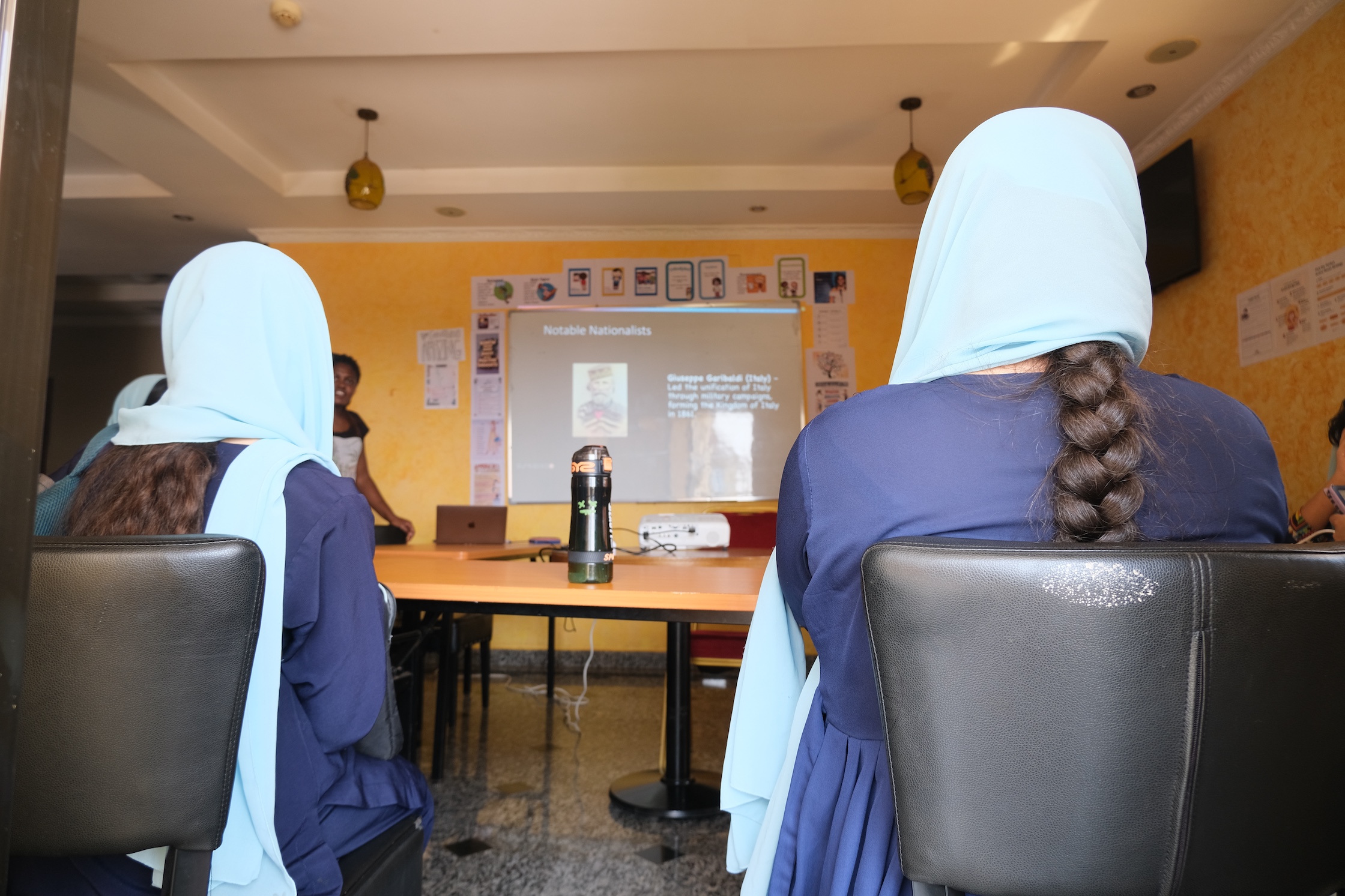
SOLA students in class in Rwanda
AB: Lastly, can you share something personal about yourself? Maybe a favorite hobby, a food you can’t say “no” to, or a small joy that helps you recharge.
SB: This may sound simple or common, but one of my greatest joys is taking long walks, quiet walks, ideally in beautiful natural settings. On these walks I have time to think, and reflect, and process ideas.
Going for long walks in quiet surroundings may not sound like much of a hobby to most people, I’ll acknowledge that. But most people didn’t grow up living under the Taliban in Afghanistan after years of civil war. Most people don’t really know what that kind of living is like. But maybe you don’t need to know, to understand.